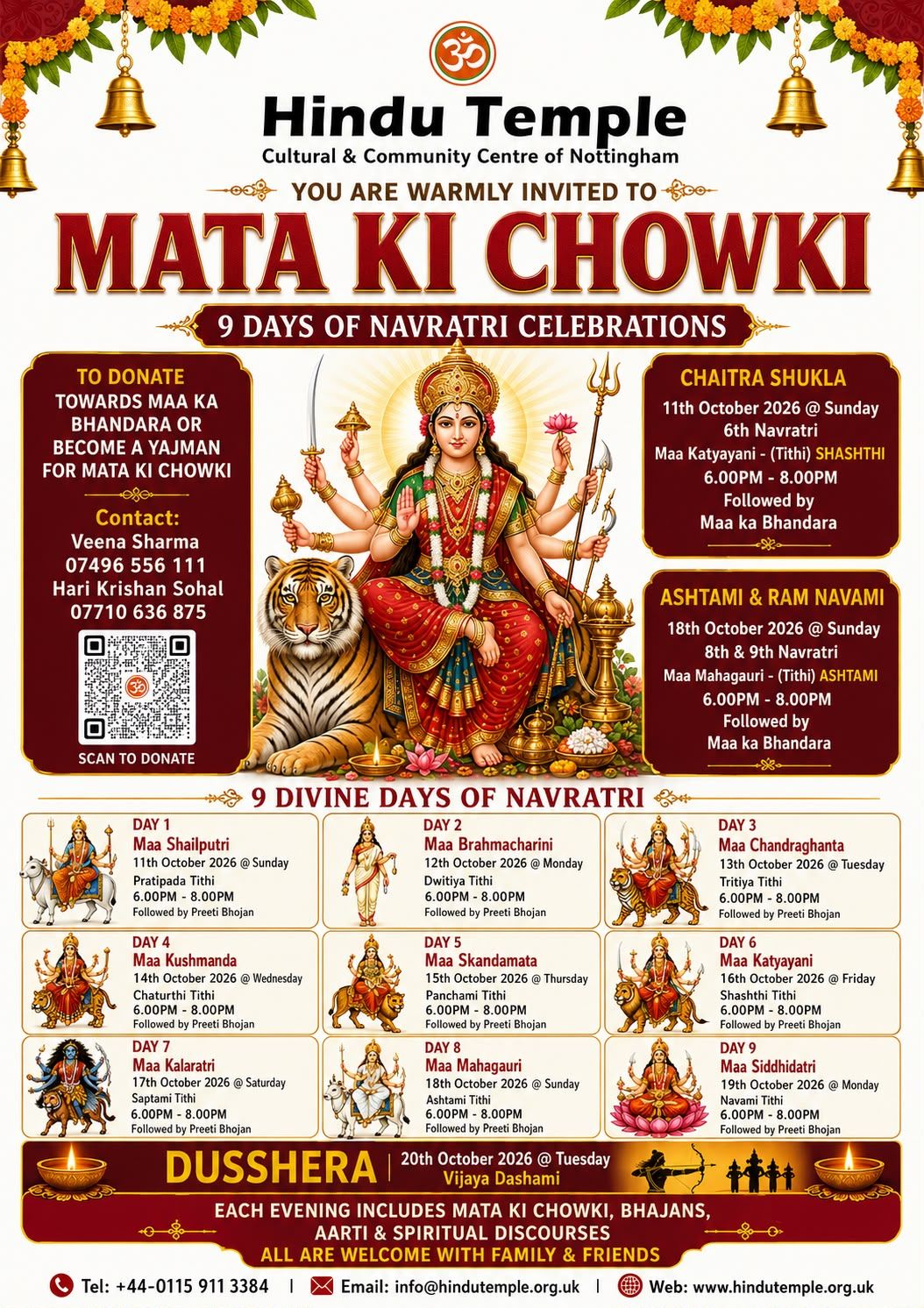
Navratra Begins - 11th October 2026 marks the start of the nine-night festival celebrating devotion, spiritual renewal, and community worship. Join us at Hindu Temple Nottingham, Cultural Community Centre for a welcoming programme of prayers and devotional activities as we begin Navratri together.
- Date:11/10/2026 18:00 - 11/10/2026 22:56
- Location 215 Carlton Road, Nottingham NG3 2FX (Map)
Description
What is Navratri in Sanatan Dharma?
Navratri (नवरात्रि) literally means “nine nights.”
In Sanatan Dharma, Shakti is the divine energy through which creation, preservation and transformation take place. During Navratri, we worship Maa Durga in her different forms and pray for strength, wisdom, purity, protection and spiritual progress.
At a deeper level, Navratri represents a battle that takes place within us.
Maa Durga's victory over Mahishasura symbolises Dharma overcoming Adharma — but it also teaches us to conquer our own inner enemies: anger (krodh), greed (lobh), attachment (moh), ego (ahankar), jealousy and uncontrolled desires (kaam).
5
Why do we celebrate for nine nights?
Traditionally, the nine days are associated with the Navadurga — nine manifestations of Maa Durga:
| Day | Form of Maa | Simple meaning |
|---|---|---|
| 1 | Shailaputri | Stability, purity and beginning the spiritual journey |
| 2 | Brahmacharini | Tapasya, discipline and devotion |
| 3 | Chandraghanta | Courage, peace and protection |
| 4 | Kushmanda | Creative divine energy and positivity |
| 5 | Skandamata | Motherly love, compassion and protection |
| 6 | Katyayani | Strength to overcome negativity |
| 7 | Kalaratri | Destruction of fear, darkness and evil |
| 8 | Mahagauri | Purification, peace and forgiveness |
| 9 | Siddhidatri | Wisdom, fulfilment and spiritual accomplishment |
One traditional way of understanding the journey is that we first ask Maa to help remove our negative qualities, then cultivate good qualities and inner discipline, and finally move towards knowledge and spiritual understanding.
What should we actually do during Navratri?
Navratri isn't simply about not eating certain foods. Upvas literally carries the idea of coming or remaining near the Divine. Food discipline is a tool; changing our thoughts and behaviour is the bigger purpose.
A simple Sanatan approach is:
- Wake, bathe and begin the day with a clean mind and sankalp to observe Navratri sincerely.
- Keep your home and puja place clean. Traditionally a diya is lit and Maa Durga is worshipped.
- Offer simple things such as flowers, fruit, water and prasad according to your family tradition.
- Recite “ॐ दुं दुर्गायै नमः — Om Dum Durgayai Namah”, Durga Chalisa, Devi Kavach or passages from Durga Saptashati/Devi Mahatmya according to your ability and tradition.
- Attend aarti, bhajan, kirtan or temple worship where possible.
- If fasting, eat simple satvik vrat food according to your family's sampradaya. Many devotees avoid meat, alcohol, onion, garlic, grains and heavily processed foods, though fasting customs vary considerably.
- Most importantly, practise satya, daya, seva, self-control and forgiveness. Try particularly hard to avoid anger, arguments, gossip, intoxication and harmful behaviour.
- Give daan or seva. Feeding others and helping somebody genuinely in need are beautiful ways of honouring Maa.
You don't have to prove devotion by undertaking an extreme fast. A person who cannot fast can still observe Navratri through satvik food, prayer, restraint, seva and sincere bhakti.
The message of Navratri
The beautiful thing about Navratri is that the story isn't only “Maa Durga defeated a demon thousands of years ago.”
It asks:
What is the Mahishasura inside me that I need Maa's strength to defeat?
Maybe anger. Ego. Greed. Jealousy. Laziness. Addiction. Resentment.
So each morning we can pray:
“Maa, give me Shakti to overcome what is wrong within me, Buddhi to recognise Dharma, and Bhakti to remain close to you.”
That is a very Sanatan way of approaching the nine nights — Shakti outside us reminds us to awaken the Shakti within us.